Hair Length Chart & Visual Guide
Compare hair lengths from short pixies to extra-long classic hair with exact measurements in inches and centimeters, body landmark milestones, and curl shrinkage factors.
Stylist Note: Visual body fall varies based on height, torso proportions, curl texture, and shrinkage. Use these measurements as standardized reference benchmarks.
The Hair Length Spectrum
Explore the continuous physical gradient of human hair. Tap or hover any spectrum marker to inspect landmark geometry, centimeters, and styling physics in real-time.
Mid-Back Length (MBL)
The golden median of modern hair length. Flows across shoulder blades with dramatic movement, volume retention, and light reflection.
Falls below shoulder blades on straight hair; curls bounce to collarbone/APL level (12″–14″ visual).
Butterfly layers, 90s bombshell blowout, loose curling wand cascades.
Hair Length Explorer
Select or slide to any length to view instant inch-to-centimeter conversions, typical body landmarks, growth timelines, and styling notes.
18-Inch Hair
Bra-strap line / Mid-back area
An 18-inch measurement may fall differently depending on the person's height, body proportions, and hair texture.
Falls across the shoulder blades to the bra-strap line or mid-ribcage. Rich styling versatility for voluminous curls and updos.
Real Hair Length Visuals
Authentic human hair length references with anatomical landmark measurement lines on straight, wavy, and full-body silhouettes.
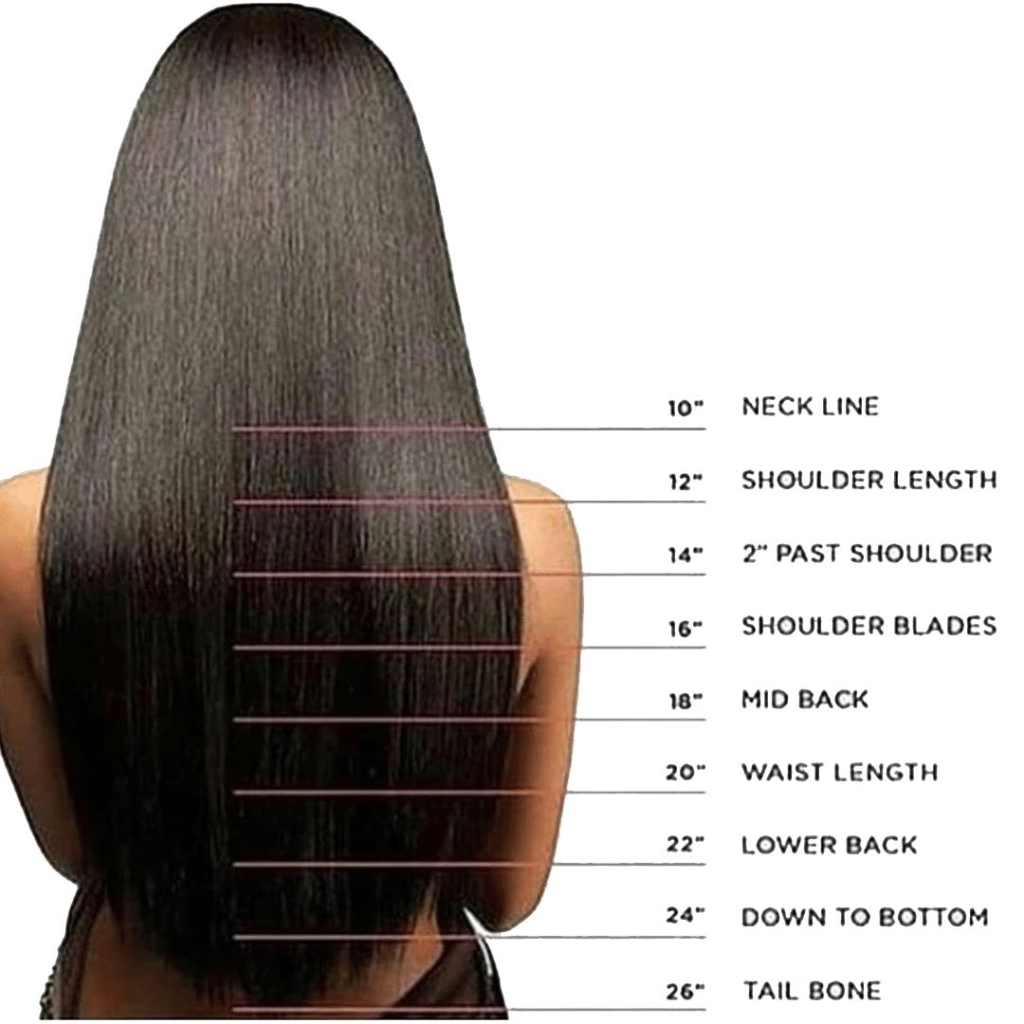
Straight Hair Length Chart (Inches)
Silky 1A–1B physical fall from 10″ Neck Line to 26″ Tailbone
Pro Consultation Tip: Use these real human hair fall references during your salon consultation or before purchasing hair extensions to ensure exact desired physical landmark placement.
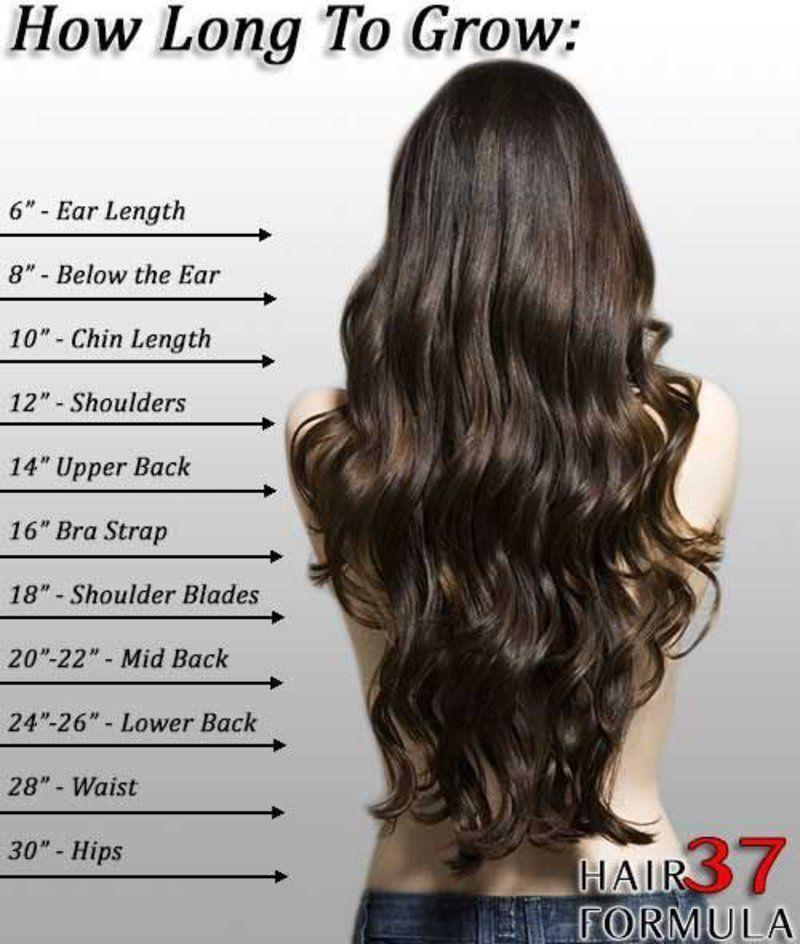
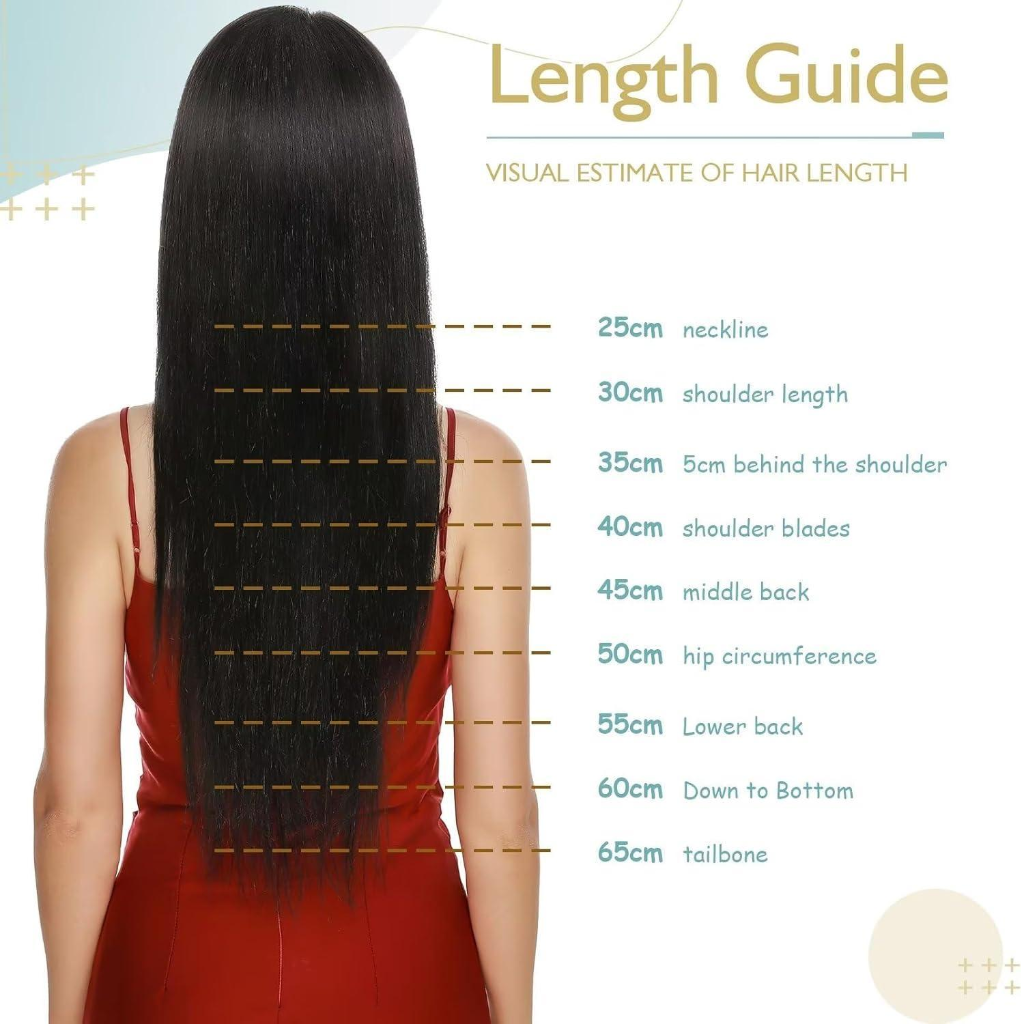
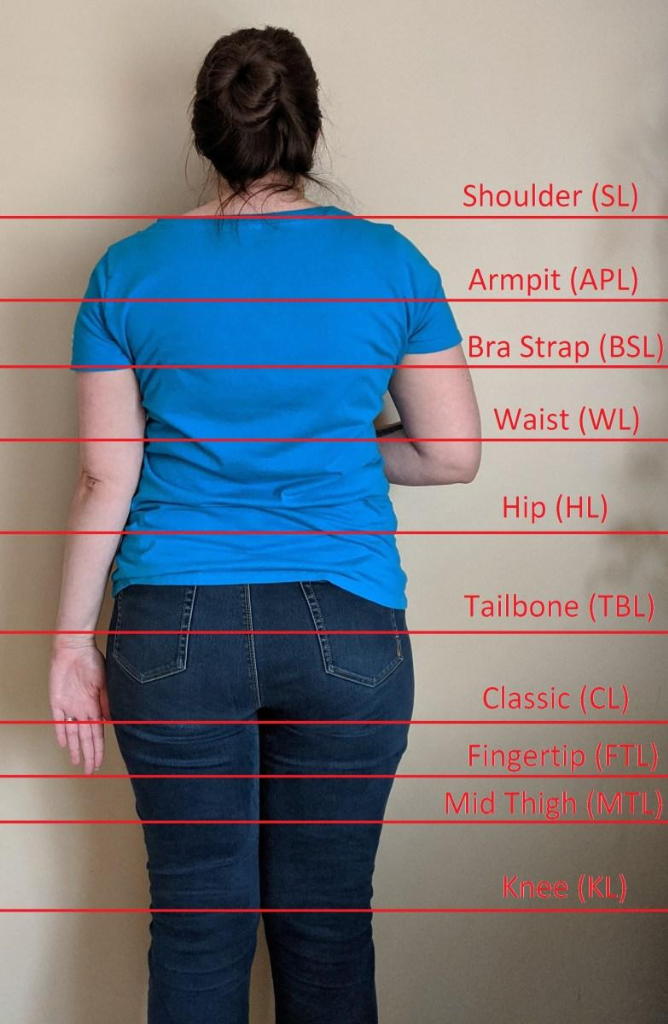
Visual Hair Length Progression Matrix
From close crops down to classic lengths, explore how industry standard length tiers map to anatomical body landmarks.
How Long Is Your Hair?
Explore detailed breakdowns for the most commonly researched hair length milestones in inches and centimeters.
How long is 18-inch hair?
18-inch hair is one of the most sought-after salon lengths. It extends past the underarms to the bra-strap line, providing flowing movement, dramatic curls, and full ponytail volume.
Approximately 36 months (3 years) from a close crop
On wavy hair (Type 2), 18 inches appears around 15–16 inches. On coily hair (Type 4), it may hover near the collarbones.
Hair Length Comparison
Compare any two hair lengths side-by-side to calculate the exact difference in inches, centimeters, and estimated growth timeline.
Hair Length Categories
Understand how salons, stylists, and extension manufacturers categorize hair lengths across standardized tiers.
Very Short Hair
Very short cuts and closely cropped styles that sit close to the scalp. Encompasses buzz cuts, fades, textured crops, and micro pixies. Highlights facial features and bone structure with low daily styling time.
Short Hair
Short styles extending through the ears, jawline, or upper cheekbones. Highly customizable with texturizing, curtain bangs, and perimeter tapering without resting on the shoulders.
Medium Hair
Hair ranging from the chin and neck through the shoulder ridge and collarbone. Often celebrated as the most universally adaptable length, easily transitioning between loose styling and full updos.
Long Hair
Hair extending beyond the shoulders toward the back, covering armpit level (APL), bra-strap line (BSL), and mid-back. Offers maximum styling versatility for voluminous curls, waves, and bridal updos.
Very Long & Extra Long
Hair extending from the natural waist toward the hips, tailbone, and classic sub-gluteal fold. Demonstrates dedicated length retention, moisture balance, and protective styling discipline.
How to Measure Hair Length Accurately
Follow these practical, standardized steps to measure your hair at home with precision and consistency.
Establish Your Starting Anchor Point
Place the 0-mark of a flexible tailor’s tape measure at your anchor point. For total back length, use the vertex (highest point of your crown). For face-framing sections or bangs, start directly at the front hairline where your part begins.
Select a Consistent Section of Hair
Isolate a small, clean 1-inch section from the chosen landmark. When tracking growth over time, always use the same quadrant (such as center-crown or behind the ear) to maintain consistency.
Follow the Natural Curve of the Head
Allow the measuring tape to rest flat along the natural contour of your head and down your spine or chest without bunching or stretching the tape itself.
Gently Extend the Strand to the Longest Tip
Smooth the section of hair down along the tape with your fingers and note where the longest healthy strand ends. Avoid pulling aggressively on the root.
Record Stretched vs. Unstretched Length
If you have wavy, curly, or coily hair, record both: the physical stretched length (for true growth tracking) and the natural resting length (for visible aesthetic reference).
Maintain Consistent Conditions for Tracking
Always measure under similar conditions (e.g., damp vs dry, freshly detangled vs styled) when calculating monthly growth progress.
Why Different Measurement Techniques Produce Different Numbers
Measuring from the crown (vertex) down the spine yields the highest inch number because it traverses the entire height of the cranium. In contrast, measuring from the nape of the neck will register 6 to 8 inches shorter for the exact same physical hair ends. Neither technique is wrong—consistency in using the same starting point is what matters for accurate growth tracking.
Why Does Curly Hair Look Shorter?
Two people may have the exact same 18-inch measured hair length, yet one person's hair rests at mid-back while the other's hovers near the collarbone. This visual difference is caused by curl pattern curvature and shrinkage.
Unlike straight hair fibers that hang linearly downward under gravity, curly and coily fibers twist through three-dimensional space in spiral helixes, ribbon waves, and tight zig-zag angles.
Shrinkage is a direct reflection of healthy strand elasticity and strong internal hydrogen bonds. When hair is dry and unstretched, shrinkage naturally elevates the visible hemline of the cut.
Shrinkage Rates by Hair Type
18″ Measured Strand*Measured length refers to the physical fiber length gently extended taut. Visual length refers to the natural hang position when dry.
Does Height Affect Where Hair Length Falls?
Because hair length charts use standard body landmarks, your height, torso length, and skeletal frame dictate where a specific inch measurement will land.
Case Study: Where 20 Inches of Hair Falls by Height
A fixed 20-inch (50.8 cm) strand measured straight down the back on different adult heights:
With a shorter spinal column and compact torso, 20 inches of hair easily surpasses the bra-strap line and reaches the natural waist or upper hip bones.
Standard community hair charts are calibrated to this frame. 20 inches falls across the shoulder blades to the bra-strap line and mid-ribcage.
Due to an elongated neck and longer vertical spine, 20 inches of hair rests closer to the armpits and upper shoulder blades, requiring 24″–26″ to reach the waist.
Neck Length
A difference of just 1.5 inches in neck height changes whether a bob touches the collarbone or floats above it.
Torso Proportions
People with short waists reach waist length faster than people with long torsos of identical overall height.
Back Musculature
Broader lats and shoulders displace hair laterally, slightly reducing direct downward hang.
Hair Length Chart for Men & Women
While hair strand biology and measurement standards are universal, styling goals and terminology vary across men's and women's haircut routines.
Hair Length for Women
In women’s styling and extension sizing, milestones are centered on visual harmony with jewelry, necklines, and clothing cuts:
- Short (2″–8″): Pixies, bixies, French bobs, and jawline-framing cuts.
- Shoulder Length (12″–14″): Collarbone lobs, butterfly layers, and effortless daily volume.
- Long Hair (16″–22″): Armpit and bra-strap milestones for voluminous blowouts and bridal updos.
- Waist & Extra Long (24″–36″+): Mermaid waves, protective braids, and floor-grazing statement hair.
Hair Length for Men
In barbering and men’s grooming, length references often correspond to clipper guard numbers and tied style viability:
- Buzz & Short Cuts (0.5″–3″): Fades, crew cuts, ivy leagues, and textured crops.
- Medium Flow (4″–8″): 90s middle-part curtains, surfer waves, and slick backs.
- Shoulder Length (10″–14″): Full man-bun, top-knot, and rocker flow.
- Long Hair & Locs (16″–24″+): Natural dreadlocks, warrior braids, and chest-sweeping manes.
Frequently Asked Questions About Hair Length
Expert answers to the most common questions regarding hair measurements, body milestones, and conversion standards.
01How do I measure my hair length accurately?
Use a flexible vinyl tailor’s tape measure. For standard overall length, place the zero mark at the vertex (highest point of your crown) or at your natural parting line, let the tape drape down along your spine or chest, and gently extend the longest strand straight against the tape to the tips. For bangs or layers, measure from the root of that specific section.
02How many centimeters is 12 inches of hair?
12 inches of hair is exactly 30.48 centimeters (calculated as 12 × 2.54 cm). In salon charts and haircut guides, 12-inch hair typically represents classic shoulder-length hair on an individual of average height.
03How long is 18-inch hair and where does it typically fall?
18-inch hair is exactly 45.72 centimeters. On an individual of average height (5’4″ to 5’6″ / 163–168 cm), 18-inch hair typically falls between the armpits and the bra-strap line (mid-back). On shorter frames it may reach the mid-back curve, while on taller frames it sits closer to the shoulder blades.
04How long is 24-inch hair?
24-inch hair is exactly 60.96 centimeters. It is widely recognized as the entry point for natural waist-length hair on average-height bodies, resting near the narrowest point of the waist or navel level.
05What hair length is officially considered "long hair"?
In the cosmetology and hair extension industries, hair is generally classified as "long" once it passes the collarbone and reaches armpit length (APL), which is approximately 14 to 16 inches (35.5 to 40.6 cm) and longer. Lengths beyond 24 inches (61 cm) are commonly classified as "very long" or "extra long."
06What measurement in inches is considered shoulder-length hair?
Shoulder-length hair typically measures between 12 and 14 inches (30.5 to 35.6 cm) when measured from the crown on straight hair. For curly or coily hair, the measured stretched length may need to be 14 to 18 inches to achieve a visible shoulder-length resting position due to shrinkage.
07Why does curly hair look shorter than straight hair of the identical length?
Curly and coily hair fibers grow in helical spirals, corkscrews, or zig-zags rather than straight downward. Depending on curl pattern tightness and ambient humidity, shrinkage reduces visible hang length by 20% in loose curls (Type 3A) and up to 75% or more in tight coils (Type 4C). A measured 18-inch coil may visually rest at shoulder level until gently extended.
08Does a person’s height affect where hair falls on their body?
Yes. Anatomical landmarks like the collarbone, armpits, bra-strap, and waist are spaced further apart on taller bodies. For example, 20 inches of hair might reach the waist on a person who is 5’1″ (155 cm), but only reach the mid-back or shoulder blades on someone who is 5’11″ (180 cm).
09Is hair length measured from the scalp or the crown?
Both methods are used, but they serve different purposes. Measuring from the crown/vertex is standard for determining total body landmark fall down the back. Measuring directly from the scalp/root of an individual section is standard for tracking monthly growth rate or measuring specific layers and bangs. Consistency in using the exact same starting point is key when tracking progress over time.
10Should curly hair be measured stretched or unstretched?
For true scientific growth tracking, haircut length consistency, and purchasing hair extensions or wigs, hair should always be measured gently stretched taut. Unstretched measurements only record your visual resting length, which changes with humidity, styling products, and curl definition.
Related Hair Reference Guides
Deep-dive into connected haircut, extension, and growth milestone resources.
Hair Growth Timeline
Month-by-month growth milestones from buzz cut to waist.
Haircut Length Chart
Clipper guards #0 to #8 in mm and inches.
Hair Extension Length Chart
10″ to 36″ bundles and wigs with visual fall.
Braiding Hair Length Chart
Knotless, box braids, twists, and locs.
Hair Length Tools & Calculators
Use our specialized interactive utilities to calculate growth timelines, convert measurements, and simulate visual milestones.
Hair Length Calculator
Calculate the exact difference in inches and centimeters between your current hair length and your target goal.
Hair Growth Calculator
Estimate realistic timeframes and monthly milestones needed to reach your target hair length.
Hair Length Visualizer
Explore interactive 2D anatomical models showing how lengths fall on different body heights and textures.
Hair Length Converter
Convert hair measurements between inches and centimeters with exact mathematical precision.
Hair Length Comparison
Compare two hair lengths side-by-side to understand visual drop differences and growth timelines.
Hair Extension Comparison
Compare bundle and weave lengths side-by-side to choose the right length for your height.